
An Introduction to the Book of Esther
The book of Esther is most unique in the Hebrew Bible. God is never mentioned by name. It tells the story of a Persian queen who rises to power amid scandal and danger. The narrative confronts us with difficult questions about the choices of those who claim to be God’s people. Is it possible to learn anything about God and his purposes from the book of Esther? Here is the scene.
The Backdrop of Esther’s Story
In 586 BC, the southern kingdom of Israel, Judah, was conquered and its people forcibly relocated to Babylon by King Nebuchadnezzar. The Babylonian regime lasted nearly fifty years, until it was toppled by Cyrus, a brilliant military leader who had united the Medes and Persians in what is now modern-day Iran. A member of the Achaemenid clan, Cyrus instituted the Persian (or Achaemenid) Empire.
As he built one of the largest empires in ancient history, Cyrus was careful to show tolerance toward the nations he conquered. Recognizing the unique story of the Jewish people, he granted them the right to worship their God freely. He even allowed them to return to their homeland to rebuild Jerusalem and the Temple. Under the leadership of three charismatic leaders—Zerubbabel, Ezra, and Nehemiah—some Jews returned to their ancestral land.
The majority of Jews, however, did not undertake the long journey back to Judea. They remained in Babylon and, over time, gradually spread to other parts of the known world.
The Persian Empire was an advanced, expansive, and notably tolerant civilization. Today, it is best known for its conflicts with the Greek city-states during the Greco-Persian Wars. Under Darius I (522-486 BC), the Persians invaded Greece but were driven back after their defeat at the Battle of Marathon in 490 BC.
His son, Xerxes I (486-465 BC), invaded Greece a second time. Though temporarily delayed at the battle of Thermopylae, he was ultimately defeated at Salamis and subsequently returned to Persia. This Xerxes is likely the same ruler as the biblical character Ahasuerus, who reigns in the book of Esther.
Such is the tumultuous background to Esther. In a world where the chosen nation is no longer prominent, it could seem that God had moved on, leaving the Jews to find for themselves as the great powers wrestle. Yet this is exactly the point where the book of Esther occurs, proving quite the opposite.
Book of Esther: Summary
With such vast international events underway, the story of Esther shifts to the domestic scene, revealing a very personal portrait of life in the royal palace, as well as God’s secret working in daily affairs. This is unfolded in each chapter of Esther as follows.
Chapter 1 – Ahasuerus holds a great feast and summons Queen Vashti to display her beauty before the revelers. When she refuses, the king becomes furious. His counselors recommend that, in order to prevent women throughout the kingdom from becoming disrespectful toward their husbands, Vashti be punished by being replaced as queen.
Chapter 2 – The king’s counselors recommend a search for beautiful virgins throughout the empire. These young women are gathered into the royal harem in Susa, the capital, from whom the king selects his next queen. Esther, a Jewish girl, is the one the king favors, and she is made queen. Meanwhile, her uncle Mordecai uncovers a plot against the king’s life.
Chapter 3 – Ahasuerus promotes Haman, a fierce enemy of the Jews, to a position of great political prominence. Haman is especially enraged by Mordecai’s refusal to show him deference. He casts lots (pur) to determine the most favorable day to destroy the Jews. Haman then approaches the king and secures blanket approval for his plan—without ever revealing which people he intends to destroy.
Chapter 4 – Upon hearing this news, the Jews fall into deep distress, weeping, fasting, and wearing sackcloth. Mordecai sends word to Esther, urging her to intercede with the king on behalf of her people. Esther resolves to do so, fully aware that approaching the king could cost her life if her plan fails.
Chapter 5 – Esther comes before the king and invites both the king and Haman to attend a feast she has prepared. At that feast, she asks them both to return for another feast the following day. Meanwhile, Haman grows increasingly livid at the mere sight of Mordecai.
Chapter 6 – Unable to sleep, the king has the official records read to him. There he discovers the account of Mordecai’s role in thwarting a plot against his life and resolves to honor him. When Haman arrives early the next morning, the king instructs him to bestow public honor on Mordecai as a great man in the kingdom.
Chapter 7 – At the feast, Esther pleads for the lives of her people and exposes Haman’s plot against the Jews. Haman begs for his life, and the king, enraged, orders that he be executed.
Chapter 8 – Unable to reverse his earlier decree, the king grants the Jews the legal right to defend themselves against their enemies. Mordecai is elevated to a position of prominence within the kingdom.
Chapter 9 – The day meant for the Jews’ destruction becomes a day of deliverance. Many of their enemies are defeated, and the Jews are granted a second day to defend themselves. The descendents of Haman are also executed. In remembrance of these events, the Jews also establish the feast of Purim to celebrate their deliverance.
Chapter 10 – The book concludes by highlighting the greatness of King Ahasuerus and the prominence and honor of Mordecai throughout the kingdom.
Themes in Esther
The book of Esther, which at first appears to be an arcane tale of Persian palace intrigue, contain deep and fascinating threads. The book hints at a demonic war which is waged against God’s purposes, as well as God’s subtle but sovereign influence in history to accomplish his will.
Genocidal Intent
In the book of Esther, we are confronted with an attempt to annihilate the Jewish people—an effort that is not unique in history. This theme surfaces early in the Hebrew Bible, when Pharaoh sought to destroy the nation prior to the Exodus. Athaliah attempted to wipe out the dynasty of David, and later, King Herod sought to kill the infant Jesus.
This pattern is not accidental. Knowing that God’s Son would enter the world through the Jewish nation and the family of David, the devil repeatedly attempts to wipe out these people in order to thwart God’s plan.
As a side note, although the Messiah has now come, the Jewish people remain significant in salvation history, as Romans 11 makes clear. For this reason, the satanic attempt to destroy them continues into the present day: through pogroms, the Holocaust, and even ongoing antisemitism in the modern world.
Dempster (223) points out that in Esther there is “a fundamental awareness of the fact that the Jewish nation will survive because of an overarching purpose to history.” Indeed, at one point we find Haman’s own wife prophesying his downfall. Even this gentile woman recognizes that Mordecai will ultimately overcome because he is a Jew. This “is the most absolute statement in the book that history has a pro-Jewish shape to it” (Webb).
Haman and Mordecai
There is much more to these men’s conflict than may appear at first glance. A thousand years earlier, at the time of the Exodus, the Israelites were confronted by the nation of Amalek. After Israel’s victory, God declared, “The LORD has sworn; the LORD will have war against Amalek from generation to generation” (Exodus 17:16).
Later, in the book of Numbers, Balaam prophesies concerning Amalek: “And he looked at Amalek and took up his discourse and said, “Amalek was the first of the nations, But his end shall be destruction”” (Numbers 24:20).
Five hundred years after the Exodus, Israel again goes to war with Amalek. King Saul is commanded by the prophet Samuel to attack the Amalekites and Agag, their king. God commands Saul to utterly destroy the Amalekites, leaving none alive. Nevertheless, “Saul and the people spared Agag and the best of the sheep, the oxen, the fatlings, the lambs, and all that was good, and were not willing to destroy them utterly; but everything despised and worthless, that they utterly destroyed” (1 Samuel 15:9).
This theme reappears in Esther 3:1: “After these events King Ahasuerus promoted Haman, the son of Hammedatha the Agagite, and advanced him and established his authority over all the princes who were with him.” Here, Haman is explicitly identified as an ‘Agagite,’ that is, a descendent of Agag, the king of the Amalekites.
And what about Mordecai? He is described as “Mordecai, the son of Jair, the son of Shimei, the son of Kish, a Benjamite” (Esther 2:5). King Saul, too, was a Benjamite, a son of Kish. Just as Saul confronted Agag, so now Mordecai encounters Haman. This is the classic line-up: the covenant nation facing Amalek. God’s people are confronted by the satanic race, the nation perpetually at war with God’s purposes.
The Presence of God in Esther
God is never mentioned in the book of Esther, a theme defined by absence. Even when fasting and prayer are described, the author seems deliberately to avoid naming him. To the reader, it may appear as though God is completely absent from the story.
Yet, as Hamilton (540) observes, “There are so many ‘what if’ situations in Esther that if these are not traceable to a divine hand, then a better title for the book is ‘Coincidences.’” Clearly, God is present, even if his ways are hidden. For those who are willing to look for him, traces of his presence can be seen throughout the book of Esther.
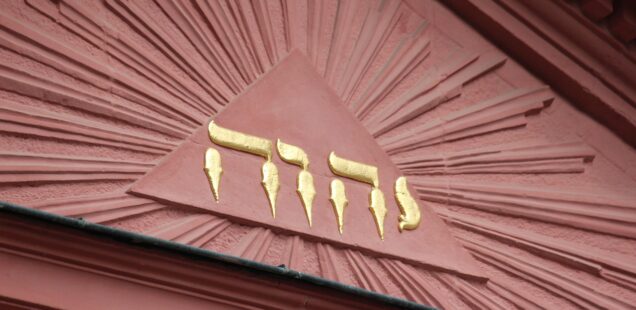
Careful study of the Hebrew text of Esther has revealed that the name of God, Yahweh (YHWH), is embedded within the structure of the book. Scholars have identified five acrostics in which the divine name appears.
> Esther 1:20: the four initial letters spell the divine name backwards
> Esther 5:4: the four initial letters spell the divine name forwards
> Esther 5:13: the four final letters spell the divine name backward
> Esther 7:7: the four final letters spell the divine name forward
Finally, and perhaps most significantly, in Esther 7:5, the king asks, “Who is he, and where is he?” He is asking about Haman, but the reader is prompted to ask the larger question: Who and where is God in all of this? The answer lies in the words of the king, given in another acrostic—the “I Am” (‘HYH) mentioned in Exodus 3:14, when God dramatically reveals himself to Moses at the burning bush.
In short, God’s fingerprints are evident throughout the book of Esther for those who are willing to search for him.
The Great Reversal
The book of Esther is filled with stark contrasts and dramatic shifts. The story begins with Persian-sponsored banquets, which are later mirrored by the Jewish-sponsored feasts that Esther hosts. The day set aside for Jewish genocide ends up bringing about the destruction of their enemies. Haman’s promotion ultimately paves the way for Mordecai’s elevation. Jewish dread turns to euphoria, and Jewish fasting to feasting. Mordecai’s sackcloth is replaced with royal robes—made of the same rich fabrics and colors as those of the king (compare 8:15 with 1:6).
Despite the seemingly insurmountable challenges facing God’s people in this world, and even his apparent absence, Esther’s many reversals foreshadow a greater future reversals. The Enemy will be overthrown, and those who were oppressed will emerge as the victors.
A Traditional Jewish Blessing in Response to the Reading of Esther
“Blessed are You, My Lord, our God, King of the Universe, (the God) Who takes up our grievance, judges our claim, avenges our wrong; Who brings just retribution upon all enemies of our soul and exacts vengeance for us from our foes. Blessed are You My Lord, Who exacts vengeance for His people Israel from all their foes, the God Who brings salvation.”

In place of comments, I would love to hear from you personally. Please reach out to me via the Contact Page to share your thoughts and perspectives on this post!

Enjoying this content? Subscribe to receive it directly in your email, once a week.